
Sheet Skew Measurement System
IS416
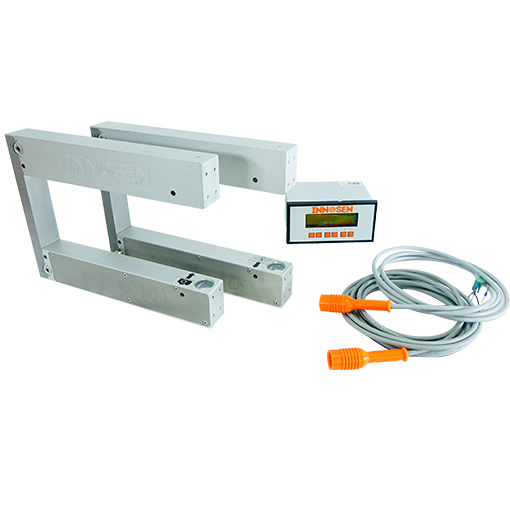
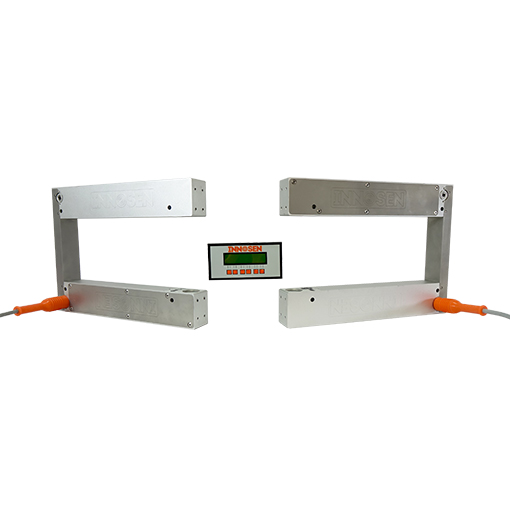
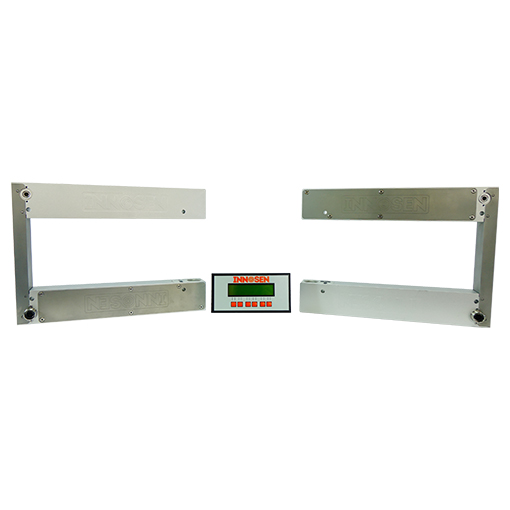
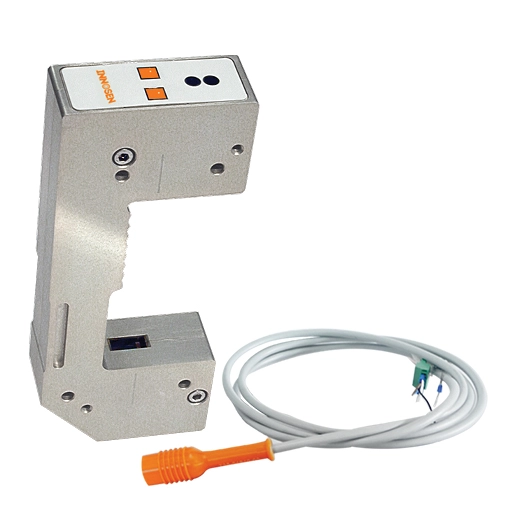
The Innosen IS416 Sheet Skew Measurement System detects rotated sheets at the coater exit on 3-piece canmaking lines. Operators set the skew tolerance, and the system flags out-of-tolerance sheets before misaligned lacquer margins cause weld wire breakage, spoilage, or downtime. It also records skew statistics to help measure and improve process capability.
At a glance:
- No weld wire breakage from misplaced lacquer
- No unplanned welder downtime from skewed sheets
- No spoilage from out-of-tolerance coating placement
- Skew statistics for process capability improvement
- No manual calibration need
Common Questions From Canmakers
What problems do skewed sheets cause in canmaking?
On a 3-piece canmaking line, skewed sheets can move lacquer into the bare weld margin. When this misaligned coating reaches the welder, it can cause weld wire breakage, poor weld quality, spoilage, and unplanned downtime.
The IS416 detects sheet skew at the coater exit, before misplaced margins create problems downstream. The cheapest place to catch a skewed sheet is at the coater — not after the can reaches your customer.
How does skew data improve process capability and line speed?
Detection catches out-of-tolerance sheets. Skew statistics help improve the process.
The IS416 records sheet skew data, including averages and variation, so canmakers can see how the feeding and coating process behaves over time. This helps teams detect drift, measure process capability, and adjust based on evidence instead of trial and error.
Using IS416 statistics to increase coating line speed in controlled steps, manufacturers following Innosen’s method have achieved approximately 7% higher line speed.
Read the full method: How to Maximize Your Coating Line Speed →
Where is the IS416 installed on the line?
The IS416 is typically installed at the coater exit, between the coater and oven, so skewed sheets can be detected before curing. It can also be installed at the slitter infeed.
How does the IS416 detect sheet skew?
The IS416 lets operators set the skew tolerance for their product and process. During production, it automatically detects sheets that rotate beyond that limit before they create downstream problems.
Detection is continuous, and no manual calibration is needed. Its robust measurement heads, durable cables, and easy-clean window design are built for the coating environment, helping reduce maintenance time.
What upgrades does the IS416 bring over the IS415?
The IS416 is the upgraded generation of the proven IS415 Sheet Skew Measurement System, rebuilt for durability in the coating environment:
- More robust construction across all parts of the system
- Stronger, sturdier cables built to last longer in production conditions
- Redesigned windows with better protection, easier to clean — less cleaning time, easier maintenance
- Thinner vertical head sections, adding 90 mm of total sheet-width capacity without readjustments
Which add-on modules complete sheet positioning control?
Skew is one of three sheet positioning errors that put coating in the wrong place. The IS416 is the foundation of a complete sheet positioning control system:
- IS430 MK II Sheet Translation Measurement System — adds protection against laterally displaced coating by detecting sheets that drift sideways (“translate”) at the coater.
- IS450 Sheet Registration Measurement System — adds protection against poor sheet registration by detecting sheets that arrive too early or too late at the coater.
Together, the three systems verify that every sheet arrives straight, centered, and on time — so the coating lands exactly where your process needs it.
FEATURES
|
SPECIFICATIONS
| Dimensions: | Heads: 40 x 244 x 333 mm Controller: 143 x 71 x 107 mm |
| Power supply: | Camera and Trigger Heads are powered from the Controller |
| Temperature: | 0 to 45°C (32 to 113°F) |
| Humidity: | 0-90% non-condensing |
| Environmental protection rating: | IP54 |
| Sheet speed: | Up to 150 m / min |
| Range of measurement: | ±5mm (±0.2”) |
| Resolution: | ± 0.2mm (0.008”) in center (at focus point) |
| Connection cables: | Standard 5 meter (16.5 feet) cable with straight connector to each Head. Use only cables supplied by Innosen. Longer cables and cables with right angle connectors are available. Max cable length should not exceed 10 meters (33 feet) |
| Permissible vertical sheet movement: | 25mm (1”) on the center position, 25mm (1”) up from lower window |
SPARE PARTS
| PART DESCRIPTION | PART NUMBER |
| Trigger Head | 212-54804-00 |
| Trigger Head Cable 5 way 5m straight connector | 706-13221-00 |
| Trigger Head Cable 5 way 10m straight connector | 706-13221-04 |
| Trigger Head Cable 5 way 5m right-angle connector | 706-13281-00 |
| Trigger Head Cable 5 way 10m right-angle connector | 706-13281-01 |
| Camera Head | 212-54802-00 |
| Camera Head Cable 12 way 5m straight connector | 706-19341-00 |
| Camera Head Cable 12 way 10m straight connector | 706-19341-01 |
| Camera Head Cable 12 way 5m right-angle connector | 706-19361-00 |
| Camera Head Cable 12 way 10m right-angle connector | 706-19361-01 |
| IS416 Controller | 212-54810-00 |
| Cable Boot | 735-54840-00 |
| IS416 Window Protection Glass | 211-54853-00 |
| IS416 Mounting Kit | 211-54816-00 |
Media
Frequently Asked Questions
What is the IS416 Sheet Skew Measurement System?
- The Innosen IS416 is a sheet skew measurement system for 3-piece canmaking lines. It detects sheets that have rotated beyond a user-set tolerance at the coater exit, preventing misplaced coating from causing weld wire breakage, weld roller damage, and downtime.
Why do skewed sheets cause weld wire breakage?
- Interior lacquer is applied to the flat sheet with the weld margins left uncoated. A rotated sheet places lacquer inside the weld margin; that lacquer contaminates the weld wire and rollers during welding, causing wire breakage, roller damage, or poor-quality welds.
Does the IS416 require manual calibration?
- No. The IS416 operates without manual calibration.
Can the IS416 help increase line speed?
- Yes. The IS416 records skew statistics that quantify your process capability. Manufacturers following Innosen’s statistical monitoring method have increased coating line speed by approximately 7% while maintaining quality.
What is the difference between sheet skew, translation, and registration?
- Skew is rotation of the sheet; translation is sideways drift; registration is early or late arrival at the coater. The IS416 measures skew, and the IS430 MK II and IS450 add-on modules extend coverage to translation and registration for complete sheet positioning control.
Related Products
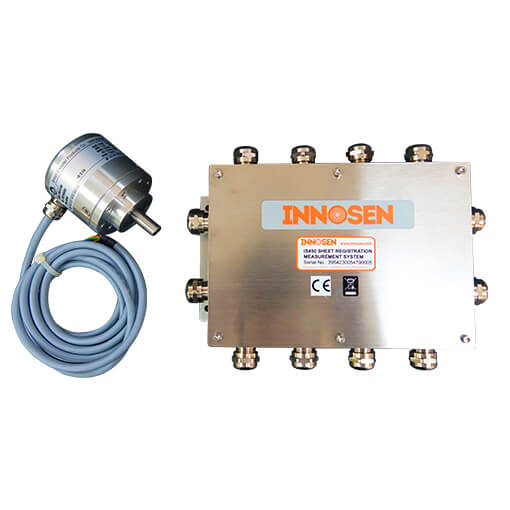
IS450 Sheet Registration Measurement System
Adds protection against poor sheet registration by warning of sheet misfeeds at the coater.
IS430 MK II Sheet Translation Measurement System
Adds protection against laterally displaced coating by detecting sheet misalignment at the coater.