

Missing lacquer is any area of a coated sheet that leaves the coater without the lacquer it should carry. On a sheet coating line it has three common causes: partially overlapped sheets, lacquer starvation and contamination in the coating machine. Each cause leaves a different pattern on the sheet, so how many IS651 Missing Lacquer Detectors you need, and where they go, depends on which causes you guard against.
Key takeaways on missing lacquer
- A sheet with missing lacquer looks like every other sheet on the stack. The damage shows up later as can corrosion, blunted press tooling, crown caps that do not seal, and customer complaints.
- Partially overlapped sheets leave a bare band across the full width. One sensor catches them.
- Lacquer starvation leaves a bare strip along the left or right edge. Two sensors, one per edge, cover both sides.
- Contamination leaves a bare patch about 200 mm wide, anywhere on the sheet. Covering a 1,200 mm sheet takes about six sensors.
- Start with one sensor, count what it catches, and add more only if your own quality data says you need them.
Why does missing lacquer matter?
A sheet with missing lacquer does not look wrong. The problem shows up later in the process, where it costs more to contain:
- Corrosion. The internal coating is the barrier between the product and the bare metal of the can. Where it is missing, the product attacks the exposed metal, sometimes long after the can has left the plant.
- Tooling damage. On DRD and deep-draw presses, an uncoated blank can blunt the press tooling.
- Leaking closures. On crown cap presses, the base plate must be lacquered for the sealing gasket to adhere to the cap.
- Cost. Each of these ends in spoilage, unplanned downtime or customer complaints.
Because one coated sheet becomes many can bodies, a single sheet that escapes the coater uninspected produces a batch of defects, not one.
What are the three causes of missing lacquer?
The pattern on the sheet tells you the cause, and the cause decides how many detectors you need and where they go.
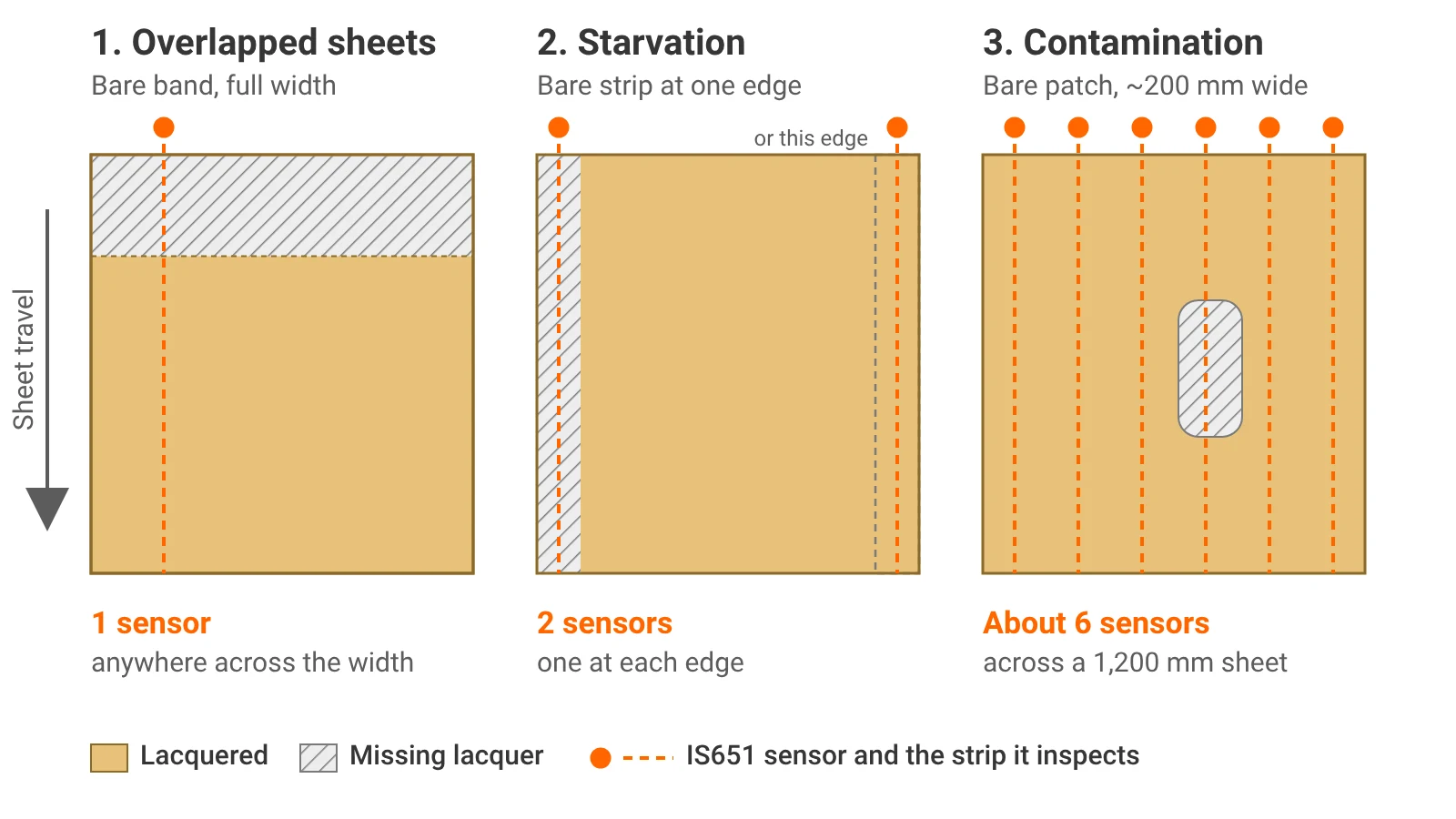
| Cause | What you see on the sheet | IS651 sensors needed |
|---|---|---|
| Partially overlapped sheets | A bare band across the full width, where one sheet covered the other | 1 |
| Lacquer starvation | A bare strip along the left or right edge; you cannot predict which | 2, one per edge |
| Contamination | A bare patch about 200 mm wide, anywhere across the sheet | About 6 across a 1,200 mm sheet |
1. Partially overlapped sheets
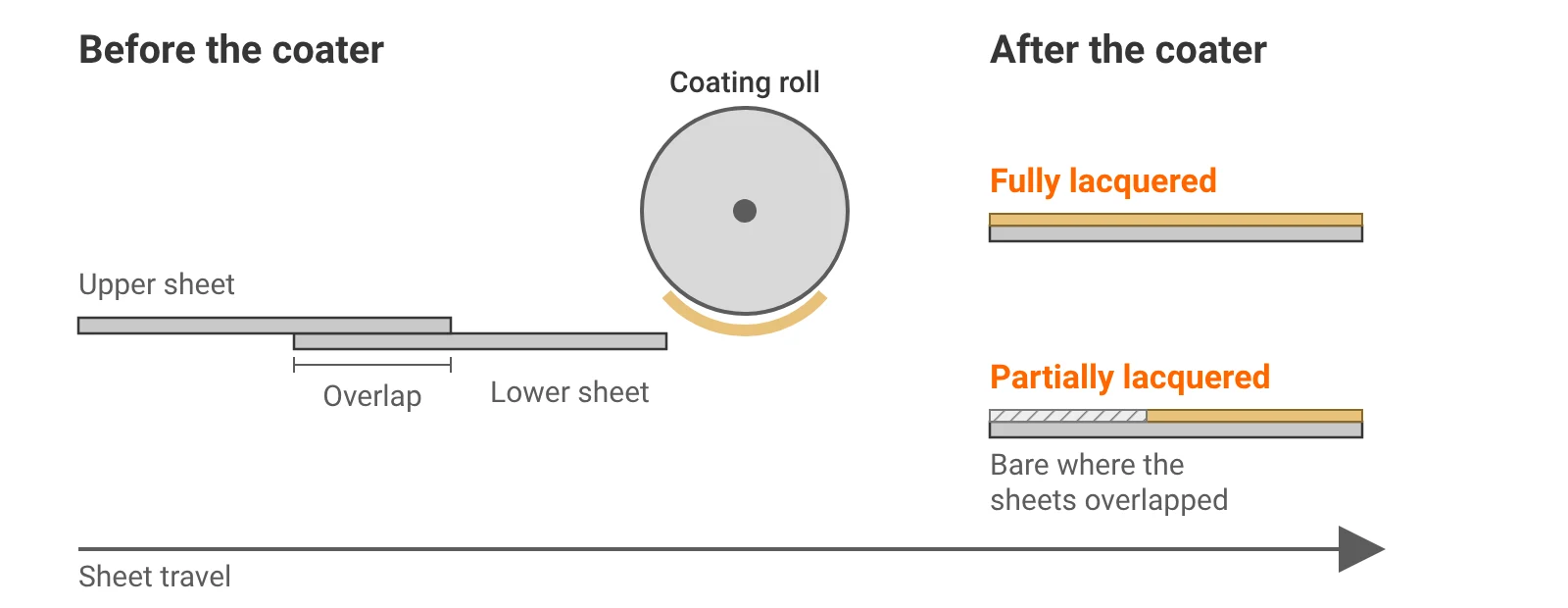
When two sheets enter the coater partly overlapping, the coating roll lacquers the upper sheet completely, but the part of the lower sheet that was covered gets no lacquer. The sheets separate afterwards, and the lower sheet carries a bare band across its full width.
Because the band runs the full width of the sheet, a single detector catches it wherever it is mounted across the sheet.

2. Lacquer starvation
Lacquer starvation happens when the day tank is not topped up or refilled in time and the coater runs short of lacquer. The coating fails at the edges of the sheet first, leaving a bare strip along one side.
You cannot predict whether it will be the left edge or the right, so full protection takes two detectors: one guarding each edge.

3. Contamination
Contamination is the least frequent cause. A label or a cleaning rag travels through the coating machine and stops the lacquer from reaching part of the sheet. A label usually spoils one sheet. A rag can indent the coating roll, and then sheet after sheet comes out with the same defect, which means sheet scrap and downtime.
A contamination defect is typically about 200 mm wide and can fall anywhere across the sheet, so covering a 1,200 mm sheet takes about six detectors.

How many missing lacquer detectors do you need?
Each IS651 inspects a strip about 15 mm wide, running in the length direction of the sheet. Covering a 1,000 mm sheet edge to edge would take around 67 sensors, which is not an economical way to solve the problem.
A better approach is to start from your own quality data: which defects occur, how often, and how many sensors it takes to catch most of them. For most canmakers, the starting point is a single sensor fitted about 100 mm in from the edge of the narrowest sheet they run. It detects:
- Effectively all partially overlapped sheets
- Lacquer starvation on the edge it guards
- Some of the defects caused by contamination
Run it and count what it catches. If more faults still get through than you can afford, add a second sensor at the opposite edge, then more across the width. Contact Innosen to plan the sensor positions for your sheet sizes and line.
Where should a missing lacquer detector be installed?
The IS651 Missing Lacquer Detector inspects every sheet at line speed, up to 1,200 sheets per minute with a 3 millisecond response time, and sends a reject signal when it finds missing lacquer. It is installed at:
- Coating lines: the coater outfeed or the wicket oven outfeed, where a defect costs the least to contain.
- DRD and deep-draw presses: the press entrance.
- Slitters: the first operation table.
It detects white, colored and clear lacquers, down to a minimum lacquer weight of 2 g/m² depending on the lacquer. It calibrates itself and relearns after every lacquer changeover, so there are no settings for operators to adjust.
Recommended solutions
- Missing Lacquer Detector IS651 – detects uncoated and partially lacquered sheets at line speed, including clear varnish.
- Missing Side Seam Lacquer Detector IS670 – checks the lacquer stripe over the welded side seam of three-piece can bodies.
Which missing lacquer defects reach your press?
Start with one IS651 and let your own quality data decide whether you need more.
FAQs about missing lacquer
What causes missing lacquer on coated sheets?
There are three common causes: partially overlapped sheets entering the coater, lacquer starvation when the day tank is not refilled in time, and contamination such as a label or rag passing through the coating machine.
What is lacquer starvation?
Lacquer starvation is when the coater runs short of lacquer, usually because the day tank was not topped up in time. The coating fails at the edges first, leaving a bare strip along the left or right edge of the sheet.
How many missing lacquer detectors do I need?
One IS651 catches effectively all partially overlapped sheets. Two, one at each edge, cover lacquer starvation on either side. Catching contamination anywhere across a 1,200 mm sheet takes about six. Most canmakers start with one sensor and let their quality data decide.
How wide is the strip one IS651 inspects?
Each IS651 inspects a strip about 15 mm wide, running in the length direction of the sheet.
Where should a missing lacquer detector be installed?
On coating lines, at the coater outfeed or the wicket oven outfeed. On DRD and deep-draw presses, at the press entrance. On slitters, at the first operation table.
Does the IS651 detect clear lacquer?
Yes. The IS651 detects white, colored and fully clear lacquers, down to a minimum lacquer weight of 2 g/m² depending on the lacquer.
What is the difference between the IS651 and the IS670?
The IS651 checks lacquer coverage on coated sheets. The IS670 checks the lacquer stripe over the welded side seam of three-piece can bodies.