
UV LOGGER
IS310
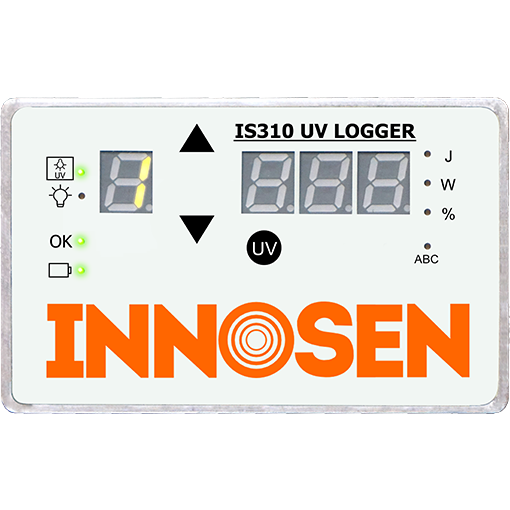
The IS310 UV Logger reads the power and energy of every UV lamp in your curing oven — lamp by lamp, at 1,000 samples per second.
Credit-card sized. Free analysis software. The specification of loggers costing several times more.
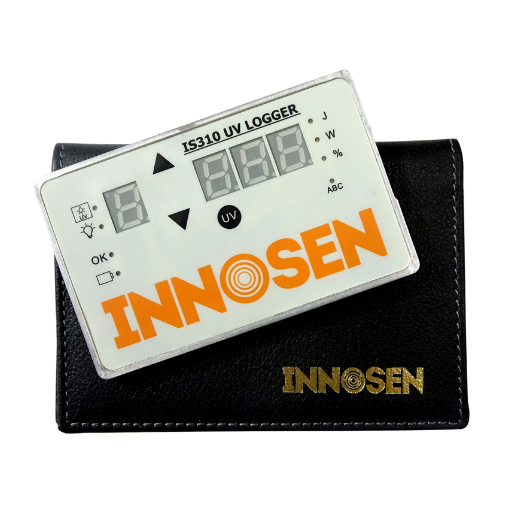
The IS310 UV Logger is Innosen’s credit card-sized UV data logger for UV curing ovens on metal packaging lines. It measures total UV energy in J/cm² and peak UV power in W/cm², records the contribution of up to 9 individual lamps in a single pass, and stores reference values for up to 9 ovens or lines so lamp degradation is reported as a percentage.
A cure that fails is rarely a mystery. Lamps age, reflectors get dirty, a lamp and reflector assembly slips out of focus — and the first evidence is rubbed-off print, set-off on the sheet stacked below, or a batch that never dried. By then the sheets are made.
The IS310 puts a number on the oven before that happens. Pass it through with the sheets, read Joules and Watts on the LED display, then download the graph to the free IS310 Utility Software and look at each lamp’s curve. Lamps get replaced when the data says so rather than on a calendar, and lamp current can be trimmed back toward the real cure limit instead of being left high to be safe.
Measure the oven. Stop paying for the margin.
Not every UV logger reads the same number.
Feed two loggers through the same oven at the same speed and the Joules should agree. When the Watts do not, the difference is in the instrument rather than the oven — and four things explain almost all of it: how fast the logger samples, how wide its detector window is, how quickly its analog front end responds, and how thick it is.
Mains-driven UV lamps switch on and off twice per mains cycle, once every 8.3 ms at 60 Hz. A logger sampling at 100 Hz can step straight over a peak. The IS310 samples every 1 ms, through a fast analog front end and a 0.8 mm detector window, so a narrowly focused line is read as a peak instead of being averaged into the area around it. And at 6 mm thick it sits close to the plane being cured: peak power falls with the square of the distance from the lamp, so a logger three to four times thicker reads a markedly lower peak from the same lamp.
Total energy is barely affected by any of this. Peak power is affected by all of it — which is why two loggers can agree on the dose and disagree on the focus.
How it works
Read more about UV curing in Canpedia®.
Built for the shift, not the lab.
Every part of the IS310 was shaped by what a coating line actually allows — a gap of a few millimeters, a moving sheet, gloves, and no chance to stop the line.
Every peak, captured.
1,000 samples per second — one reading every millisecond, fast enough to resolve lamps switching at mains frequency.
Lamp by lamp.
Peak power, energy and percentage degradation for up to 9 individual lamps, from one pass through the oven.
Six millimeters thin.
86 × 54 × 6 mm. It goes through gaps as small as 6 mm, with the sheets, during normal production.
A 0.8 mm window.
A narrow detector aperture reads a focused line as a peak instead of smearing it across the area beside it.
Nine ovens, one instrument.
Reference values for up to 9 ovens or lines held on board, with memory for 130,000 data points.
Software at no charge.
The IS310 Utility Software plots every pass, saves and imports references, and prints reports. Included, not licensed separately.
Charges from a phone charger.
USB rechargeable. Give it a full charge once a month and it is ready for the next pass.
Common Questions From Canmakers
What is the IS310 UV Logger?
The IS310 UV Logger is Innosen’s credit card-sized UV data logger for UV curing ovens in metal packaging. Measuring 86 × 54 × 6 mm, it passes through the oven with the sheets and records total UV energy in J/cm² and peak UV power in W/cm² for up to 9 individual lamps per pass.
What does the IS310 UV Logger measure?
The IS310 measures two things: total UV energy in J/cm², the dose the coated surface received, and peak UV power in W/cm², the intensity at the top of each lamp’s curve. Energy falls when lamps age or a reflector is dirty; peak power falls when the lamp and reflector lose focus. Read together, they separate a dose problem from a focus problem.
Features
| Features |
|---|
| Measures total UV energy (J/cm²) and peak UV lamp power (W/cm²) in a single pass |
| Per-lamp resolution — peak, energy and percentage degradation for up to 9 lamps per oven reading |
| Reference values stored for up to 9 UV ovens or production lines |
| 1,000 samples per second (one reading every 1 ms) behind a fast analog front end |
| 0.8 mm detector window for accurate peak reading on narrowly focused lines |
| 6 mm overall thickness — passes through openings as small as 6 mm during normal production |
| Integrated magnets hold the logger in position on the metal sheet |
| Digital LED display with J, W and % indicators |
| Adjustable detection range, four selectable options |
| Auto peak detect and continuous measurement modes |
| On-board memory for up to 130,000 data points |
| Free IS310 Utility Software for graphing, reference comparison and reporting |
| Rechargeable battery, charged over USB from a standard phone charger |
| Readings unaffected by mains frequency |
| Supplied with a protective carrying pouch |
| Annual recalibration available from Innosen service centers in Spain and the Philippines |
Specifications
| Specifications | Value |
|---|---|
| Measured parameters | Total UV energy (J/cm²); peak UV lamp power (W/cm²) |
| Spectral range | 260–400 nm (UV broadband), peak response at 370 nm |
| Detection range | Adjustable, four selectable options (for example 0.014–3.0 W/cm²) |
| Sample rate | 1,000 samples per second (1 ms interval) |
| Detector window | 0.8 mm |
| Lamps per reading | Up to 9 individual lamps |
| Ovens or lines stored | Up to 9 reference sets |
| Memory | Up to 130,000 data points |
| Display | Digital LED, with J / W / % indicators |
| Measurement modes | Auto peak detect; continuous measurement |
| Attachment | Integrated magnets |
| Dimensions | 86 × 54 × 6 mm (3.4 × 2.1 × 0.24 in) |
| Minimum oven opening | 6 mm |
| Power | Rechargeable battery, USB micro charging |
| Mains sensitivity | Not influenced by mains frequency |
| Data transfer | USB to PC |
| Software | IS310 Utility Software for Windows, supplied free |
| Calibration | Annual, at Innosen service centers (Spain, Philippines) |
| Part number | 395-51500-00 |
Supplied and services
| Supplied and services | Detail |
|---|---|
| IS310 UV Logger (395-51500-00) | The logger itself, factory calibrated |
| Protective carrying pouch | Supplied with the logger |
| USB micro cable | Charging and data transfer to a PC |
| IS310 Utility Software | Free Windows software for graphing and reference comparison |
| Annual calibration service | Full re-calibration at Innosen service centers in Spain and the Philippines |
| Application support | Send oven type, logger graphs, lamp current setting and lamp age to your local Innosen office for help reading your data |
Media
Watch the IS310 UV Logger in action on YouTube.
PLACEHOLDER — hidden on all devices. Replace with a real IS310 UV Logger customer quote, then clear the Disable On setting to publish it.
Frequently Asked Questions
Why do two UV loggers give different readings in the same oven?
- Start with the Joules. Feed both loggers through the same oven, in the same position, at the same line speed. If total energy agrees, the spectral response and calibration of the two loggers are close. If the Watts then differ, four things account for almost all of it: sample rate, because a logger sampling at 100 Hz can step over a peak that lasts a fraction of a mains cycle; detector size, because a 10 mm detector averages a 5 mm focused line across the area beside it; analog response time, because a large-area detector integrates and smooths fast changes; and thickness, because peak power falls with the square of the distance to the lamp. The IS310 samples every 1 ms through a 0.8 mm detector window and is 6 mm thick.
How fast does the IS310 UV Logger sample?
- 1,000 samples per second, which is one reading every millisecond. Mains-driven UV lamps switch on and off twice per mains cycle, once every 8.3 ms at 60 Hz, so a peak has to be caught inside that window. Sampling five to ten times within it is what makes peak detection reliable, and a 1 ms interval clears that comfortably.
Can the IS310 UV Logger measure each UV lamp separately?
- Yes. A single pass resolves up to 9 individual lamps, and the display scrolls through peak power, energy and percentage degradation for each one. That is what turns a low total energy reading into an instruction: if lamp 2 is down, lamp 2 gets the current increase or the replacement, instead of the whole bank being changed.
How thin is the IS310 UV Logger, and why does thickness matter?
- The IS310 is 86 × 54 × 6 mm and passes through openings as small as 6 mm. Thickness matters because the detector can never sit exactly where the lacquer is. Peak power is proportional to the inverse square of the distance from the lamp, so every millimeter of logger thickness lifts the detector further out of focus and lowers the peak reading. Total energy is unaffected, because the photons reach the detector either way, which is why a thick logger can agree on dose and still under-read focus.
Does the IS310 UV Logger come with software?
- Yes, at no extra cost. The IS310 Utility Software for Windows plots every pass as a graph of W/cm² against time, lists measured Joules and Watts for each lamp, and lets a known-good oven be saved as a reference and imported for comparison later. A region-of-interest selection returns total Joules, peak Watts and duration for any part of a pass.
How often does the IS310 UV Logger need charging and calibration?
- Charge it fully once a month, even when it is not in use, because leaving the battery flat damages it and voids the warranty. Calibration is annual and is carried out by Innosen certified engineers at the service centers in Spain and the Philippines, using test equipment traceable to global standards.
Innosen’s UV curing and coating quality line
IS860 CoatPro™ Coating Thickness Gauge
Measures lacquer film weight on flat sheets, formed cans, tubes and aerosols.
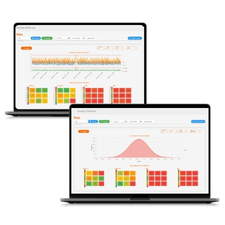
IS1100 Innolytix® Canmaking QA Software
Collects readings from Innosen instruments into one set of quality dashboards.
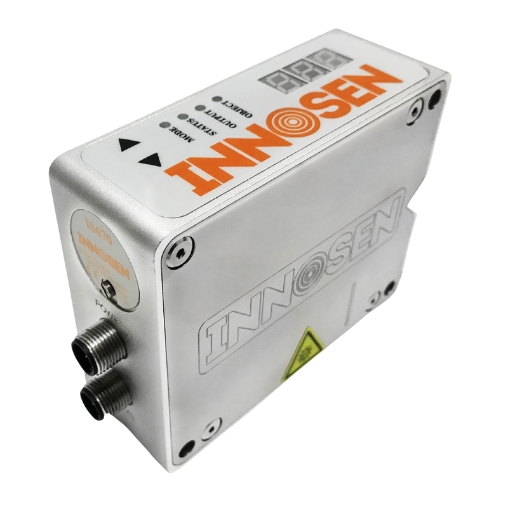
IS670 Missing Side Seam Lacquer Detector
Detects missing side seam lacquer on welded can bodies, in line, at full speed.